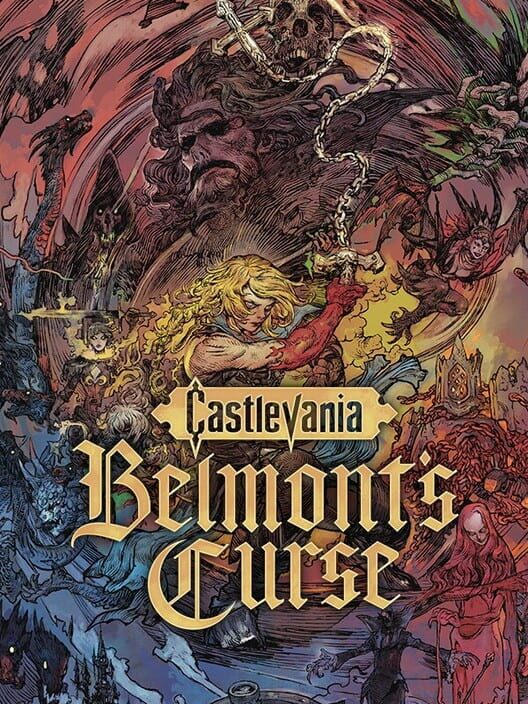
Castlevania: Belmont's Curse
Castlevania: Belmont's Curse Gameplay Features Explained
Castlevania: Belmont's Curse combines whip-based movement and combat with boss-derived Arcana, weapon categories, Relics, and exploration in medieval Paris.
Price Comparison
Castlevania: Belmont's Curse is a single-player action role-playing game built around fast whip combat, movement-driven exploration, boss-earned Arcana abilities, and equipment customization. Its central hook is that Rose Belmont can turn defeated bosses into tarot-card powers, then combine those special actions with weapons and Relics to shape her own combat approach.
The game moves the series to a burning version of medieval Paris in 1499. Trevor Belmont and his daughter Rose investigate the monsters emerging from a looming castle, while Rose becomes entangled in the conspiracy behind the invasion. Konami's store descriptions position the game as a new take on Castlevania's Gothic atmosphere, with recognizable series elements alongside new stages and systems.
Whip Combat Is Also a Movement Tool
The Vampire Killer remains the defining weapon in Belmont's Curse, but its use extends beyond striking enemies. The official description says players can crack the whip to move freely “like a trapeze artist,” making traversal part of the game's combat language rather than a separate activity.
That matters because a whip that can reposition Rose has broader tactical value than a simple long-range attack. It can potentially help create distance, close gaps, change elevation, or approach enemies from angles that ordinary running and jumping cannot provide. The store listings do not give a complete move list, so players should avoid assuming the exact inputs or limitations before playing. What is confirmed is that mastering whip mechanics is intended to support fast-paced combat and creative pursuit of enemies.
This approach should make environmental awareness important. When a game ties movement to an attack tool, platforms, overhead structures, enemy placement, and open routes can all influence how safely a fight unfolds. Rather than treating every encounter as a direct exchange of hits, players will likely benefit from looking for room to move and opportunities to use the whip's mobility.
The Arcana System Turns Bosses Into Powers
The most distinctive confirmed system in Castlevania: Belmont's Curse is Arcana. Rose seals defeated bosses into tarot cards, which become Arcana that grant skills, spells, and unique special actions. This gives boss encounters a reward structure beyond story progression or a conventional item drop.
Konami has named several returning Castlevania figures among the bosses, including Death, Medusa, and Carmilla. Joan of Arc is also identified as an enigmatic new boss. Each encounter may therefore matter twice: first as a major combat challenge, then as a source of a new tool for Rose's growing kit.
Players should think of Arcana as a system for expanding options rather than as a single fixed spell category. The confirmed wording includes both spells and unique actions, which suggests that the rewards may affect more than direct damage. Until the game provides a full in-game explanation, however, the exact selection rules, resource costs, upgrade paths, and number of equipped Arcana should not be treated as confirmed.
Why Arcana Can Change Your Approach
Boss-derived abilities can make exploration and repeat encounters more interesting because new powers may encourage players to revisit areas, test combinations, and adjust their response to different enemy types. The official material does not explicitly promise gated backtracking or a particular map structure, so that remains unconfirmed. Still, a growing pool of combat and movement-adjacent actions gives the game a clear customization layer beyond basic weapon selection.
For players who enjoy experimenting, the practical question is not simply which Arcana looks strongest in isolation. It is how a card's special action complements the weapon and Relics currently equipped. A spell that controls space, for example, could be valuable for a close-range build, while a mobility-oriented action could be more useful for a player who wants to stay aggressive and keep moving.
Seven Weapon Categories and Relics Support Builds
Belmont's Curse includes weapons across seven distinct categories, according to the official PlayStation and Nintendo store descriptions. The listings do not name every category or provide statistics, so it would be premature to label one category as best. What is confirmed is that weapons are meant to work alongside Relics and Arcana as part of a customizable battle style.
Relics are described as equipment that can trigger powerful effects through both offense and defense. That wording is important: the system is not presented as damage-only progression. A Relic may support survivability, alter combat behavior, strengthen a particular strategy, or provide another kind of defensive benefit. Specific effects have not been fully detailed in the public store copy.
The intended loop is clear. Players explore, discover equipment, and combine weapons and Relics to create a playstyle. That makes experimentation more relevant than permanently committing to one loadout early. When a difficult boss or enemy formation exposes a weakness in a build, changing equipment and considering a different Arcana pairing may be a more productive response than repeating the same approach unchanged.
Build Planning Without Guesswork
Because the game's detailed balance information is not yet established in the official listings, new players should focus on roles rather than assumed tier lists. A useful starting framework is to choose one weapon that feels comfortable, one or more Relics that address the main challenge being faced, and Arcana that add options the weapon lacks.
For example, a player who prefers constant pressure may prioritize tools that keep enemies within reach or help maintain momentum. A more careful player may value defensive effects and abilities that create safer openings. The goal is not to find a universally correct setup; the game's stated emphasis on combining discovered equipment suggests that adapting is part of the intended experience.
Exploration Connects the Systems
Belmont's Curse promises maps containing new features as well as elements inspired by classic Castlevania games. Nintendo categorizes the game with an “Explore to open up new areas” tag, while Konami's published description emphasizes equipment discovered through exploration. Together, those details indicate that exploration is more than scenery between boss fights.
Players looking for the game's progression systems should pay attention to optional routes and newly accessible spaces. Discoverable weapons and Relics give a direct gameplay reason to investigate beyond the critical path. New Arcana earned from bosses may also change what a player can attempt in combat, even where no additional traversal ability has been confirmed.
The setting supports that exploration focus. The adventure begins in Paris as monsters spill from the castle, but the official description also points to stages that reinterpret Castlevania's Gothic identity. Expect the game's world to balance the historical Paris premise with supernatural architecture and familiar series-inspired visual ideas.
What Is Confirmed About Modes and Accessibility
Castlevania: Belmont's Curse is listed as a one-player game with offline play on PlayStation 5, and Xbox lists it as single player. The official storefront information does not advertise cooperative multiplayer, competitive multiplayer, or cross-play, so players should not expect those features unless Konami announces them separately.
On PlayStation 5, the game supports Remote Play and DualSense vibration. PlayStation's accessibility listing also confirms individual volume controls, basic subtitles for the main story and main characters, basic controller remapping support, tutorial reminders, control reminders, and pausing during offline gameplay or cinematics. These options should help players tailor some of the experience, although the exact accessibility settings can vary by platform.
Xbox lists the game as optimized for Xbox Series X|S and identifies support for 4K Ultra HD, 60 fps or higher, cloud saves, achievements, Xbox Play Anywhere, PC, and handheld play within the Xbox ecosystem. Nintendo's official listing confirms a Nintendo Switch version and says its behavior is supported on Nintendo Switch 2. Platform-specific feature availability should be checked on the relevant storefront before purchase.
The Core Appeal of Belmont's Curse
Castlevania: Belmont's Curse is aiming for a flexible form of action exploration: a whip used for both offense and movement, bosses that become Arcana powers, and build choices shaped by weapons and Relics. The confirmed systems point to a game where execution matters, but where loadout decisions and willingness to explore should matter as well.
For Castlevania fans, the appeal is the mixture of legacy material and new structure. The Vampire Killer, Gothic settings, and familiar bosses remain in place, while Rose's Arcana gives the game a distinct progression system. Players who want a fixed, purely linear action game should note the stated emphasis on exploration and customization. Players who enjoy testing combinations and turning hard-won boss victories into new abilities have the strongest reason to pay attention.
Sources
FAQ
Frequently Asked Questions
What is the Arcana system in Castlevania: Belmont's Curse?
Rose seals defeated bosses into tarot cards called Arcana, which grant skills, spells, and unique special actions.
Does Castlevania: Belmont's Curse have whip movement?
Yes. Official descriptions state that the whip can be used for free movement like a trapeze artist as well as combat.
How many weapon categories are in Castlevania: Belmont's Curse?
The game features weapons spanning seven distinct categories, although the official store descriptions do not list every category.
Can players customize their build in Castlevania: Belmont's Curse?
Yes. Players can combine weapons, Relics, and boss-earned Arcana to customize Rose's battle style.
Is Castlevania: Belmont's Curse multiplayer?
The official PlayStation and Xbox listings describe it as a one-player or single-player game. They do not advertise multiplayer or cross-play.
Platforms
PC (Microsoft Windows), Nintendo Switch, PlayStation 5, Xbox Series X|S
Genres
Platform, Role-playing (RPG), Hack and slash/Beat 'em up, Adventure
Themes
Action, Fantasy, Horror
Game Modes
Single player
Player Perspectives
Side view
Companies
Konami, Evil Empire, Motion Twin