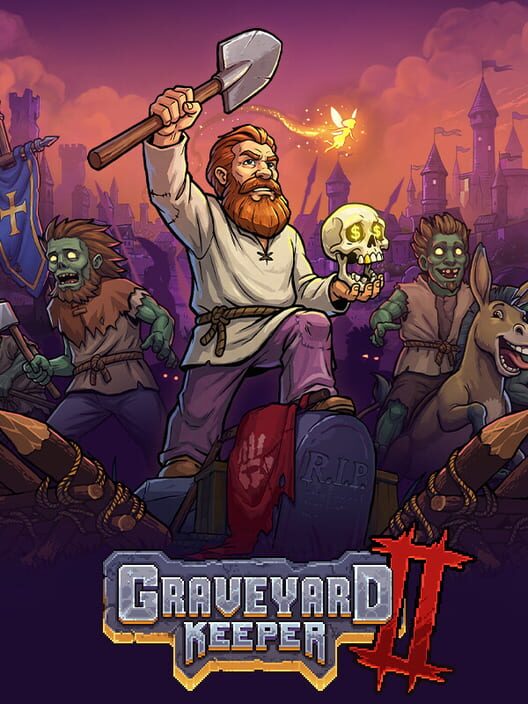
Graveyard Keeper II
Graveyard Keeper 2 Gameplay Features Explained
Graveyard Keeper 2 expands cemetery management with town restoration, zombie-powered automation, combat, fortifications, crafting, and weekly activities.
Price Comparison
Graveyard Keeper 2 combines cemetery management, crafting, town rebuilding, automation, and zombie combat in one darkly comic simulation. You take the role of the Grand Inquisitor, manage a medieval graveyard and production chain, restore a zombie-infested Town, and use undead workers and soldiers to make that work more efficient. The sequel retains the original game's morbid business-minded premise while adding a larger world, a new talent system, conveyor-belt factories, town battles, and defensive construction.
For players deciding what they will actually do from session to session, the core loop is clear: collect resources, improve the graveyard, build production infrastructure, complete town quests, develop your zombie workforce, and prepare for combat encounters. It is a single-player game, so progression and town management are designed around one player's operation rather than co-op coordination.
Manage and expand a medieval graveyard
Graveyard management remains the foundation of Graveyard Keeper 2. The official Steam description says players will build and manage their own medieval graveyard, gathering flora, fauna, and human remains to create machinery, automate production, and expand the business.
That makes the graveyard more than a decorative setting. It is a production base connected to resource gathering, crafting, and profit. The game frames these systems with the series' deliberately grim humor: materials that might be treated as purely macabre in another game are inputs for workshops, equipment, and commercial growth here.
The practical appeal is the range of jobs attached to one location. A player can spend time organizing the graveyard itself, then pivot into harvesting, crafting, upgrading facilities, or using output from those activities to support the Town. Rather than separating management and adventure into unrelated modes, Graveyard Keeper 2 presents them as parts of the same expanding operation.
Turn zombies into an automation workforce
Automation is one of the sequel's major advertised features. Steam describes zombie-based automation and structured systems that let undead workers handle heavy lifting while the player completes quests and develops the Town. Lazy Bear Games has also identified conveyor-belt factories as a newly introduced mechanic.
In practical terms, this suggests a shift from personally handling every repetitive task toward setting up systems that keep production moving. That is especially important in a game built around gathering and converting resources. As your operation grows, the value of a well-organized workflow should increase because your workers can support routine labor while you focus on construction, exploration, combat preparation, and quest objectives.
What automation changes
- Undead workers are used to support production and town-related labor.
- Conveyor-belt factories introduce a more explicit factory-style approach to production.
- Automation is tied to resource collection, machinery, and business expansion.
- Town quests can continue to matter while workers take care of background labor.
The game has not positioned automation as a completely hands-off experience. Players still need to gather, build, make decisions, and pursue objectives. The intended payoff is reducing manual busywork as your infrastructure improves, not removing the management layer that gives the game its identity.
Restore the Town through quests and rebuilding
The Town is a central new area and a major difference from the original game's smaller early-game setting. In Graveyard Keeper 2, it begins overrun by hostile zombies. You will liberate parts of it in battle, then rebuild those areas and help residents restore their homes.
Town progression is not presented as a cosmetic city-builder alone. Steam states that players will complete quests throughout the city and turn local problems into revenue. Developer posts also explain that streets cleared through combat become populated by townsfolk and market stalls. That gives combat victories a visible management result: reclaimed places become functioning parts of the town economy.
The sequel also expands exploration beyond the Town. Lazy Bear Games has said players can visit southern outskirts containing another village, tavern, forest, swamp, church, and graveyard. The game therefore appears to offer a broader world for gathering and quests while keeping the graveyard and Town as key operational centers.
Lead zombie troops in town battles
Combat is a full part of Graveyard Keeper 2 rather than an occasional self-defense system. The Steam page says you can lead a zombie army into battle and fortify the Town against the undead. Developer information describes city battles that happen in Town streets rather than in detached arenas, with different areas using different objectives.
For example, the Town Square can involve surviving enemy waves approaching from several directions, while central-street fights can require advancing on multiple fronts and capturing control points. This gives battles more structure than simply clearing enemies from a map.
Prepare before fighting
Combat preparation is connected to the management game. Materials can be used to build barricades and towers, while zombies can become combat squad members. You can place squads where you want or raise a banner and lead them personally. The developer has also said that players can craft armor and weapons, train troops, and use combat potions.
Those options point to several viable approaches: create a defensive perimeter with barriers and towers, use ranged zombie squads, lead the advance yourself, or lean on consumables and equipment. The exact balance and optimal strategies will depend on the final game, but the verified design intent is that players can use both positioning and preparation, not just direct attacks.
Town battles are also linked to the in-game calendar. Lazy Bear Games has stated that city battles are available on a specific day of the week, while the sewers are open every day and provide another place to fight zombies. This keeps a planning element in the sequel: some tasks can be tackled whenever you choose, while others are scheduled activities worth preparing for.
Progress through technology, talents, and travel upgrades
Graveyard Keeper 2 keeps a Technology Tree for progression and adds a new talent system. The developer has said the talent system is intended to make progression less grind-heavy, though the exact talent choices and unlock requirements should be discovered in-game rather than assumed from pre-release descriptions.
Players also gain a new form of fast travel. Instead of the Teleportstone used in the first game, the sequel uses Milestones to travel between unlocked locations. This matters because the world is larger and includes the Town plus surrounding regions. Milestones should make it easier to move between the places where you gather supplies, manage facilities, complete quests, and fight.
Some mechanics remain attached to particular weekdays, preserving a scheduling layer from the original game. The Town's residents generally stay at regular locations, but certain character-related activities still occur on designated days. Planning your week therefore remains useful even with better travel and more automation.
What the sequel keeps from the original
Graveyard Keeper 2 is designed as a sequel, but Lazy Bear Games has said its story is meant to be understandable for newcomers. The same Keeper returns in a changed form, familiar progression through the Technology Tree remains, and some recognizable characters return alongside new ones. Eight years have passed in the game's world since the original adventure.
For returning players, the important point is that the sequel does not abandon cemetery management in favor of combat. Graveyard work, crafting, resource collection, strange characters, and dark humor remain core features. The additions are meant to broaden the scale: the Town creates new rebuilding goals, automation becomes more factory-like, and zombie armies add a tactical combat layer.
Who will enjoy Graveyard Keeper 2's feature mix?
Graveyard Keeper 2 is best suited to players who want a management game with a deliberately absurd tone and several connected systems. It should appeal to people who enjoy building efficient production setups, gathering and crafting for long-term upgrades, and watching a neglected base or town become more productive over time.
It is also a stronger fit for players who want action alongside simulation. Battles, defensive construction, equipment, troops, and zombie squads are all part of the announced design. Conversely, someone looking only for a peaceful farming-style routine should note that reclaiming and defending the Town involves fighting hostile undead.
The clearest expectation is not a pure city builder, factory game, or action RPG. Graveyard Keeper 2 mixes each of those elements around one macabre management fantasy: build a profitable graveyard operation, make zombies work for you, and use the resulting resources to restore a town under siege.
Sources
FAQ
Frequently Asked Questions
What are the main gameplay features in Graveyard Keeper 2?
The game combines graveyard management, resource gathering, crafting, zombie-powered automation, town rebuilding, quests, combat, and defensive construction.
Can you automate production in Graveyard Keeper 2?
Yes. Official descriptions confirm zombie-based automation, undead workers, machinery, and conveyor-belt factories.
Does Graveyard Keeper 2 have combat?
Yes. Players can lead zombie squads, build barricades and towers, craft equipment, use combat potions, and fight to liberate parts of the Town.
What is the Town used for in Graveyard Keeper 2?
The Town is a major area to liberate from zombies, rebuild through quests, populate with residents and stalls, and develop into a profitable operation.
Is Graveyard Keeper 2 single-player?
Yes. Steam lists Graveyard Keeper 2 as a single-player game.
Platforms
PC (Microsoft Windows), Nintendo Switch, PlayStation 5, Xbox Series X|S
Genres
Role-playing (RPG), Simulator, Strategy, Adventure
Game Modes
Single player
Player Perspectives
Bird view / Isometric
Companies
Lazy Bear Games, tinyBuild