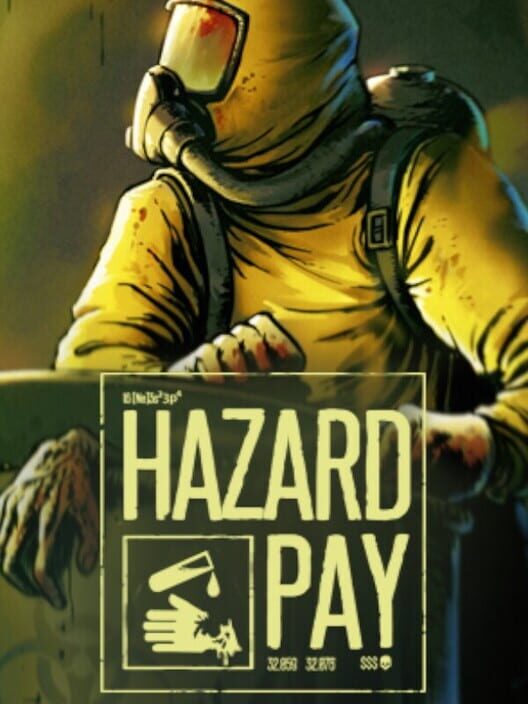
Hazard Pay
Hazard Pay Puzzle Mechanics Guide: Push, Pull and Plan
Learn how Hazard Pay's grid-based push and pull puzzles work, how environmental hazards affect each job, and how to improve your leaderboard runs.
Price Comparison
Hazard Pay is a single-player, grid-based block-pushing puzzle game built around planning routes, moving objects, avoiding hazards, and clearing evidence from contaminated facilities. Its central puzzle system uses both push and pull actions, while each compact level adds environmental complications such as chemical barrels and dangerous spaces. The practical rule is simple: do not make a move just because it is available. First establish where each object needs to finish, then preserve the space needed to get behind, beside, or away from it.
Developed by Smitner Studio and published by Numskull Games, Hazard Pay puts players in the role of a worker dispatched by the mysterious IPT organization. The assignment is to clean up hazardous sites and erase evidence, but the game frames that work through tightly constructed Sokoban-style puzzles rather than combat. It released on September 10, 2026 for Steam, PlayStation 5, and Nintendo Switch.
How Hazard Pay's Core Puzzle System Works
Hazard Pay uses grid-based movement. That means the important decisions are positional: which square you occupy, which direction an object moves, and whether a route remains open after the move. The official game description identifies push and pull mechanics as the foundation, with environmental twists layered over them.
In a conventional block-pushing puzzle, a crate can become permanently misplaced when it is pushed into a corner or against an obstacle with no way to approach it from the correct side. Hazard Pay's ability to pull objects changes that familiar equation, but it does not remove the need for foresight. Pulling gives you more ways to reposition an object, yet a level can still become awkward or impossible to complete efficiently if you block a narrow lane, fill a required standing space, or move an object before understanding its destination.
The game describes every location as a compact puzzle with moving parts. Treat each site as a closed problem rather than a place to explore freely. Before acting, identify the useful objects, the hazardous terrain, the evidence that must be collected or destroyed, and the exit or remaining open paths. A small board can be more demanding than a large one because every occupied tile has a larger effect on your options.
Push and Pull With a Destination in Mind
The safest way to approach a Hazard Pay level is to assign a job to each movable object before you start shifting it. An object may be needed to reach evidence, to interact with part of the environment, or to be disposed of. Once you understand its likely role, check the route required to move it there.
Think About Access, Not Just Direction
A push asks whether there is clear space in front of an object. A pull also asks whether you can stand in the right place and retreat without closing off your own route. Because the puzzles are grid-based, one tile can make the difference between a controlled setup and a stranded object.
When considering a move, look beyond its immediate result. Ask whether the move leaves a usable path around the object. If you need to move it again later, will you be able to approach it from the required side? If another object must pass through the same lane, which one should move first? These questions matter especially in corridors and small rooms, where a temporary placement may consume the only route that connects two parts of the site.
Delay Commitment Where Possible
Early moves are often the most consequential because they shape the rest of the board. Avoid committing an object to the edge of the level or into a confined space until you know that it belongs there. This is not a warning against progress; it is a warning against moves that reduce options without advancing a clear objective.
Pulling is useful when an object needs to be recovered from a poor position or aligned more carefully. However, it should be used as part of a route, not as a substitute for route planning. If you pull an object into your own travel lane, you may create a new obstruction even while correcting an old one.
Use the Environment as Part of the Solution
Hazard Pay's levels are not solely about placing blocks on abstract targets. The game explicitly ties its objectives to evidence cleanup and environmental interaction. Players can gather scattered documents and can push certain concealed evidence into chemical barrels to erase wrongdoing. The environment is therefore both a threat and a puzzle tool.
Chemical barrels are particularly important because they turn object movement into a disposal problem. Before moving something toward a barrel, confirm that its route is compatible with the rest of the puzzle. A disposal action may clear a tile, but the process of reaching that result can also block passages, alter available standing positions, or force you through a dangerous area.
Environmental hazards are not background decoration. Hazard Pay describes contaminated facilities where a wrong move can trap the player or lead to dissolution in acid. The exact hazards vary by site, but the strategic consequence is consistent: hazardous squares restrict where you can safely travel and can make a seemingly direct route unusable. Map them mentally before moving evidence or other objects across the board.
Plan the Evidence-Cleanup Order
Evidence objectives create dependencies between actions. Documents may require access to remote parts of a site, while other evidence may need to be moved into a chemical barrel. Start by determining which objectives are behind the most restrictive routes. Those areas generally deserve attention before you use nearby objects to seal, fill, or obstruct their access.
A useful order is to survey the whole site, identify the evidence, locate disposal opportunities, and then decide which paths must remain open until late in the puzzle. This approach reduces the risk of solving one local problem while making a separate objective unreachable.
Do not assume that a clean-looking route is the correct route. In a compact logic puzzle, the solution is often about sequencing. You may need to reposition an object temporarily, collect documents while a route is available, then return to complete the disposal task. Hazard Pay's emphasis on moving parts means that the board state matters as much as the final destination of any single object.
Move Count and Leaderboard Strategy
Hazard Pay tracks every move and ranks completed runs by final step count on global and friends leaderboards. That gives levels two goals: first, complete the job; second, improve the route once you understand the solution. A first successful run is valuable because it reveals the real sequence of dependencies. Efficiency work should come afterward.
For a lower step count, look for moves that accomplish more than one purpose. A well-positioned push may open a path and align an object for later disposal. A poorly planned detour may require several corrective pulls and pushes just to restore access. The best leaderboard routes usually come from removing unnecessary repositioning rather than from rushing movement.
When revisiting a finished level, compare your route against the board's essential actions. Ask which moves advanced an objective, which moves maintained access, and which existed only to repair an earlier decision. The third category is the clearest source of improvement. Since the game also supports friends leaderboards, efficient routes can be compared with people you know as well as the wider player base.
What to Expect From Hazard Pay's Puzzle Design
Hazard Pay is designed around more than 70 handcrafted puzzle levels, according to Numskull Games. Its dystopian story is told through the environment, while the immediate gameplay remains focused on deliberate spatial problem-solving. The dark premise and pixel-art presentation support the atmosphere, but the game succeeds or fails for a player on the strength of its route planning, object handling, and hazard management.
Players who enjoy Sokoban-style challenges should approach Hazard Pay as a methodical puzzle game with additional flexibility from pulling and additional pressure from environmental dangers. Take time to read the board, keep critical lanes open, and avoid treating object movement as reversible by default. The employer may want the scene cleared quickly, but the puzzle design rewards finishing it correctly first and efficiently later.
Sources
FAQ
Frequently Asked Questions
What type of puzzle game is Hazard Pay?
Hazard Pay is a single-player, pixel-art Sokoban-style block-pushing puzzler with grid-based push and pull mechanics.
Can you pull objects in Hazard Pay?
Yes. Hazard Pay officially lists grid-based push and pull mechanics, giving players more options than a push-only block puzzle.
What are the objectives in Hazard Pay levels?
Jobs involve cleaning hazardous facilities, gathering scattered documents, and destroying evidence, including by using chemical barrels where applicable.
Does Hazard Pay have leaderboards?
Yes. The game tracks moves and supports global and friends leaderboards based on final step count.
How many levels are in Hazard Pay?
Numskull Games says Hazard Pay includes more than 70 compact, handcrafted puzzle levels.
Platforms
Linux, PC (Microsoft Windows), Mac, Nintendo Switch, PlayStation 5
Genres
Puzzle, Indie, Arcade
Themes
Action
Game Modes
Single player
Player Perspectives
Third person
Game Engines
Godot Engine
Companies
Numskull Games, Smitner Studio