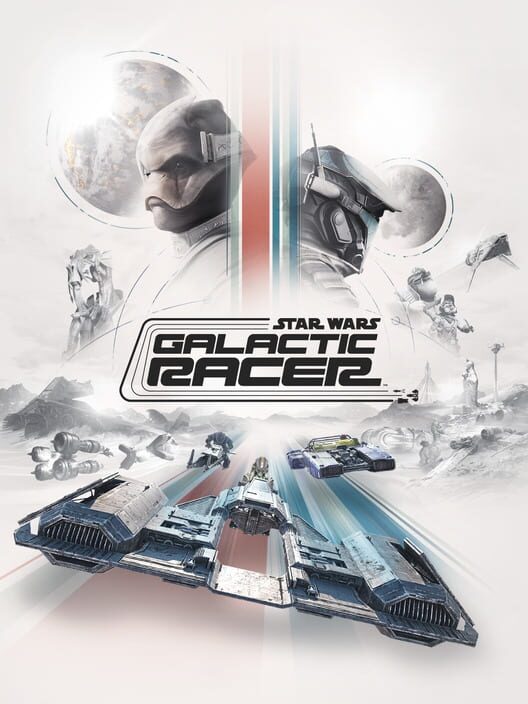
Star Wars: Galactic Racer
Star Wars: Galactic Racer Runs-Based Campaign Explained
Learn how Star Wars: Galactic Racer's runs-based campaign, event choices, crashes, carry-over unlocks, vehicle classes, upgrades, and PvP fit together.
Price Comparison
Star Wars: Galactic Racer is not structured as a conventional racing career in which every event is replayed from a fixed menu path. Its story campaign is runs-based: you guide Shade through a tour of the Galactic League, choose events as you progress, build up a vehicle configuration, and risk losing the current tour after too many crashes. Some perks and unlocks earned in earlier attempts carry into later runs, while each new tour begins with fresh decisions. That structure makes route selection, vehicle preparation, and surviving the whole tour as important as winning an individual race.
Developed by Fuse Games and published by Secret Mode, Galactic Racer puts its competition in the Outer Rim after the fall of the Empire. The game casts players as Shade, a racer pursuing revenge and glory in the underground Galactic League. Official descriptions confirm a single-player story campaign, Arcade play, and online PvP, alongside several repulsorcraft types and combat-focused racing. This guide explains what those confirmed systems mean before you commit to a campaign run.
What “runs-based” means in Galactic Racer
A run is a full attempt at progressing through the Galactic League campaign. Rather than following one immutable sequence of races, players select between different events as the tour develops. The official story-trailer description states that there is no turning back after choosing an event. Each choice can lead to different unlocks and new challenges, so one run does not necessarily expose every possible opportunity or route.
The important consequence is that a campaign decision is both a racing decision and a long-term build decision. An event may be attractive because it suits your current vehicle or because its potential unlock is useful for the rest of the tour. Conversely, an event that looks difficult may be avoidable if another available route better supports the craft and upgrades you have assembled.
This format also gives repeat attempts a purpose. The campaign is designed around regrouping and beginning a new tour after a failed run, not simply reloading one failed race indefinitely. Players should expect each attempt to involve a new chain of event choices and a new opportunity to develop a build for taking on league champion Kestar Bool.
Crashes, wreck-outs, and the cost of failure
Crashing is more than a momentary loss of position in the campaign. Official information says that a pilot who crashes too many times wrecks out of the tour. At that point, the current run ends and Shade must rebuild and start again. The exact crash limit and every condition that affects it have not been specified in the official material, so it is best not to assume that every collision carries the same penalty.
The practical lesson is clear: aggression has a strategic cost. Galactic Racer encourages racers to slam, shunt, and take down opponents, but campaign survival matters across multiple events. A maneuver that gains one position can be a poor trade if it jeopardizes a promising run. Treat risky contact as a calculated option rather than the default response to every rival.
What carries over between runs
Not every gain disappears after a wreck-out. The developer's official campaign overview says that only certain perks and unlocks earned in previous attempts carry over to the next run. This creates persistent progression while preserving the pressure of beginning each tour fresh. However, the official descriptions do not publish a complete list of permanent unlocks, their requirements, or the full carry-over rules.
That limitation matters when planning a first run. Do not assume every purchased part, race reward, or campaign advantage is permanent. Instead, consider a run successful when it teaches you how events, vehicles, and rivals interact, and when it earns any persistent perk or unlock available along the way. A run that ends short of the championship can still improve the starting options for the next attempt.
Choose events for your current build
The campaign asks players to choose events while moving through the League. Since an event choice cannot be reversed, the strongest general approach is to assess it against the vehicle and parts currently available instead of chasing a single preferred event type every time.
- Favor consistency early in a run. Before a build is established, avoiding unnecessary crash risk can be more valuable than taking the most aggressive route.
- Use unlock opportunities deliberately. Unique unlocks can matter beyond one race if they expand your options during the current tour or in later attempts.
- Adapt to the vehicle you are using. The game describes its vehicle classes as having distinct physics and playstyles, so a route that fits one craft may not be the best choice for another.
- Keep the end goal in view. The campaign ultimately builds toward confronting Kestar Bool, so preserve a setup that remains workable through escalating challenges rather than optimizing only for the next result.
This is not a promise that one route is objectively easier than another. It is a framework for making decisions with incomplete information, which is central to a runs-based campaign.
Vehicle classes and why they matter
Galactic Racer features several repulsorcraft categories: landspeeders, speeder bikes, skim speeders, and podracers. The game explicitly says that vehicle classes have distinct physics and playstyles. That means choosing a craft should not be treated as a cosmetic preference alone; it changes how the racer handles the course and how a parts build supports the vehicle.
Landspeeders, speeder bikes, and skim speeders are part of the core vehicle selection described by the official store pages. Podracers are also confirmed for the campaign and Arcade mode, with podracer-focused online multiplayer events. The official material does not provide a complete numerical handling breakdown for every vehicle, so players should avoid relying on unsupported claims about which class has the highest speed, best acceleration, or strongest combat ability.
Build around a playstyle, not a presumed tier list
Shade can visit mechanic Hibi in each planet's paddock. Hibi's workshop lets players fit new parts earned during play or bought from her, and those parts provide stat boosts and abilities intended to support different racing styles. The confirmed mechanic is therefore a build system, not just visual customization.
A sensible starting principle is to match parts to the job the craft is already doing well. If a vehicle feels manageable and stable for your approach, upgrades that reinforce that reliability may be more useful during a long campaign run than a part chosen solely for a one-race payoff. If a particular event or rival requires a different approach, use the workshop to respond before committing to the next choice.
Because the official information does not list every part, stat, ability, or shop economy rule, it is too early to prescribe exact best-in-slot builds. The reliable takeaway is that workshop choices are a major part of campaign preparation and should be reconsidered at every paddock rather than ignored.
Combat racing: when contact is worth it
Galactic Racer is explicitly a combat racer. Players can slam, shunt, and take down rivals across its circuits. That gives the races a direct competitive layer beyond clean lap execution, but the runs-based campaign makes contact a risk-management question as well.
Use contact when it has a clear payoff: protecting a position, interrupting a rival who blocks the racing line, or creating space at a decisive moment. Avoid treating every nearby opponent as a target, especially while protecting a campaign run. A collision that causes a crash can damage more than the result of one event if crashes accumulate toward a wreck-out.
This balance also applies to multiplayer. Official listings describe online PvP as strategic grudge matches where reputation is at stake, and the PlayStation and Xbox stores list support for up to 12 online players. In a PvP race, rivals will make their own decisions about aggression, so leaving room for sudden contact is part of racing defensively. Platform holders confirm online play requirements separately: PS5 online play requires PlayStation Plus, while Xbox states that console multiplayer requires a qualifying Game Pass plan.
Campaign, Arcade, and online PvP
The story campaign is the place to experience Shade's rivalry with Kestar Bool and the runs-based tour structure. It also includes paddocks, choices between events, workshop preparation, unlocks, and the threat of ending a run through repeated crashes.
Arcade is a separate way to access racing without first progressing through the campaign. The official story-trailer announcement specifically says that players can jump into podracing through Arcade as soon as they start playing. That makes Arcade the clearest choice for players who want to try a vehicle type or sharpen their racing before risking a campaign tour.
Online PvP offers another mode of play, and Steam lists cross-platform multiplayer. The official store descriptions confirm PvP and multiplayer support but do not explain every playlist, matchmaking rule, progression reward, or competitive ranking system. Treat cross-platform play as confirmed, while checking the in-game menus or current platform listing for the available events and account requirements when you play.
How to approach your first campaign run
- Learn one craft first. Pick a vehicle class that feels readable to you and give yourself time to understand its handling before constantly switching.
- Use the paddock between events. Review Hibi's available parts and make changes with the next event and your wider run in mind.
- Choose routes with a purpose. Consider the challenge, potential unlock, and how well the event suits your active build before locking it in.
- Protect the tour. Race aggressively only when the likely benefit justifies the possibility of a crash and the campaign-level consequence it may carry.
- Use failed runs as progression. Pay attention to any perks and unlocks retained between attempts, then use that knowledge to make the next tour more deliberate.
Galactic Racer's core idea is that racing skill and campaign judgment are connected. Fast driving still matters, but the game asks players to manage an entire tour: choose a path, prepare a craft, decide when to fight, and recover from a failed attempt with stronger knowledge and selected persistent rewards. That is the key to understanding its runs-based campaign.
Sources
FAQ
Frequently Asked Questions
What does runs-based mean in Star Wars: Galactic Racer?
The story campaign is built around repeatable tours through the Galactic League. Players choose events as they progress, and a run can end if Shade crashes too many times.
Do upgrades carry over after a failed campaign run?
Official information confirms that certain perks and unlocks carry into later attempts, but it does not publish a full list of every item that persists.
Can you play podracing outside the campaign?
Yes. The official story-trailer announcement says podracing is available from the start through Arcade mode, and it also appears in dedicated online multiplayer events.
What vehicle types are in Star Wars: Galactic Racer?
Official descriptions confirm landspeeders, speeder bikes, skim speeders, and podracers. The game says its repulsorcraft classes have distinct physics and playstyles.
Does Star Wars: Galactic Racer have online multiplayer?
Yes. Official store listings confirm online PvP and cross-platform multiplayer, with PlayStation and Xbox listings supporting up to 12 online players.
Platforms
PC (Microsoft Windows), PlayStation 5, Xbox Series X|S
Genres
Racing, Sport, Adventure
Themes
Action, Science fiction
Game Modes
Single player, Multiplayer
Player Perspectives
First person, Third person
Game Engines
Unreal Engine 5
Companies
Fuse Games, Secret Mode, Fuse Games