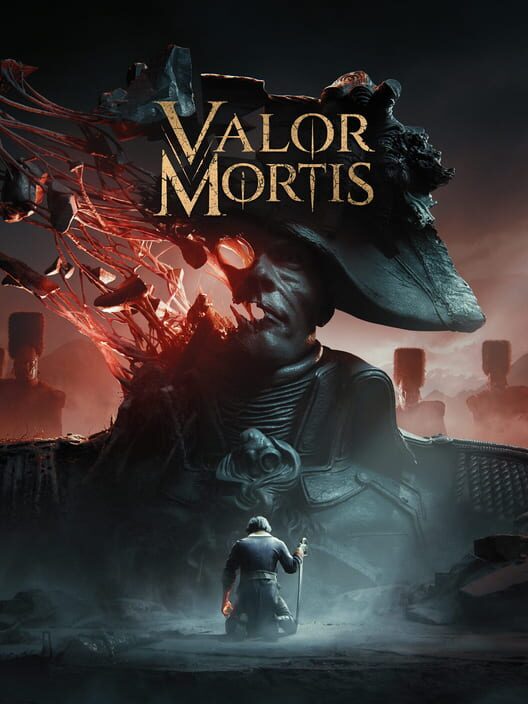
Valor Mortis
Valor Mortis Gameplay Explained: Combat, Death and Progression
Valor Mortis is a first-person soulslike built around close-range combat, supernatural powers, mobility, and progression tied to death. Here is what is officially confirmed about how it plays.
Price Comparison
Valor Mortis is a single-player, first-person action soulslike in which players fight with melee and ranged weapons, parry attacks, dash through danger, use supernatural abilities, and become stronger through death. Developed by One More Level, the game places those systems in an alternate 19th-century Europe devastated by war and a mysterious plague. The key distinction is its first-person viewpoint: rather than observing a character from behind, players must judge enemy attacks, spacing, movement, and weapon reach directly from William's perspective.
This guide covers the gameplay systems that One More Level, Steam, PlayStation, and Xbox have officially described as of October 13, 2026. Specific upgrade trees, weapon statistics, enemy behaviors, and death penalties have not been fully detailed publicly, so they should not be assumed from the game's soulslike label alone.
Valor Mortis Is a First-Person Soulslike
Valor Mortis takes the demanding combat and repeat-attempt structure associated with soulslike games and presents it through a first-person camera. You play as William, a soldier of Napoleon's Grande Armée who is brought back from a battlefield grave. He awakens in an altered Europe where a plague has corrupted the land and its inhabitants, while supernatural power now runs through him.
The first-person format matters because it changes how combat information is read. In a third-person action game, players can usually see their character's full body, weapon placement, and nearby threats at once. In Valor Mortis, the official descriptions instead emphasize direct control over parries, dashes, attacks, finishers, and mobility. Success should therefore depend on recognizing an enemy's attack timing, managing distance, and choosing safe moments to commit to an action.
Calling the game a soulslike should not be read as confirmation that every convention of the genre is present. One More Level has confirmed a demanding combat system and progression associated with death, but it has not publicly specified a stamina system, corpse-retrieval mechanic, difficulty settings, multiplayer summoning, or an exact checkpoint structure. Those details are best treated as unknown until players can verify them in the released game.
Combat Centers on Parries, Dashes and Finishers
The core confirmed combat actions are parries, dashes, and visceral finishers. A parry is a defensive action intended to meet an incoming strike at the right moment. A dash provides a rapid movement option for avoiding attacks, repositioning, or creating space. Visceral finishers are presented as high-impact close-range actions within the combat system.
That combination suggests a game that rewards active defense rather than passive retreat. A player who only backs away may stay alive in some situations, but the official combat description places equal importance on parries and finishers. The practical lesson for new players is to use early encounters to observe timing and reach instead of treating every enemy as a damage race. Learn which attacks are safer to avoid with movement and which seem designed to be challenged at close range.
Valor Mortis supports a variety of melee and ranged weapons. The developer has not published a complete weapon list or explained every weapon category's moveset, scaling, or upgrade path. Still, the presence of both melee and ranged options indicates that engagement distance is part of combat decision-making. A ranged weapon may offer an answer to an exposed target or create pressure at a distance, while melee combat remains central to parries and finishers.
Use Movement as Part of Offense
The game's dashes are not described merely as an escape tool. Valor Mortis also highlights newfound mobility for navigating the world and outmaneuvering the plague-ridden members of Napoleon's Eternal Guard. In practice, that means movement has two roles: surviving attacks during a fight and opening routes through hostile environments.
When approaching a new encounter, pay attention to the physical space around William. A narrow corridor, an elevated route, or a clear path around an enemy can change which response is safest. The official material does not confirm exact dash distance, invulnerability frames, cooldowns, or aerial movement options, so players should test those details in the game rather than relying on habits from another soulslike.
Supernatural Powers Expand Your Combat Options
William's resurrection is not just a narrative premise. His corrupted power is a central gameplay element. Official descriptions state that players can channel this power to enhance attacks and unlock new supernatural abilities that can be used against enemies.
This creates a combat layer beyond standard weapons. Rather than defining Valor Mortis only as a game about sword strikes and defensive timing, its systems combine physical weapons with powers gained through the protagonist's plague-linked resurrection. The public information does not identify every ability, their resource costs, their cooldowns, or whether players can equip multiple powers at once. What is confirmed is that abilities can be unlocked and used offensively.
For a first playthrough, the sensible approach is to consider powers and weapons together. If an ability improves an attack, test whether it helps with the weapon and combat range you use most often. If a power creates an opening or affects several threats, it may be more valuable in crowded or mobile encounters than in a one-on-one duel. Avoid assuming that a visually dramatic ability is automatically the strongest option; its real value will depend on its timing, availability, and interaction with the rest of the combat system.
Death Is Tied to Character Growth
Valor Mortis explicitly frames death as an opportunity to grow stronger. That is important because it establishes defeat as part of the intended progression loop, not simply a fail state. Players should expect to revisit difficult situations with more knowledge of enemy patterns and, potentially, new combat tools or increased capability.
However, the official descriptions do not explain exactly how this growth is awarded. They do not confirm whether every death grants a resource, whether progress is lost on defeat, whether upgrades are permanent, or how resurrection-related progression is structured. The safe conclusion is that repeated attempts have a growth component; anything more specific would be speculation.
That distinction is useful for setting expectations. Treat failures as information-gathering opportunities. Identify the attack or positioning choice that ended the attempt, then return with a deliberate adjustment: use a dash earlier, try to parry a familiar move, change range, or use a supernatural ability at a different point. This approach fits the confirmed design direction without presuming systems that have not been documented.
Exploration Has a Metroidvania-Inspired Structure
One More Level describes Valor Mortis as featuring Metroidvania-inspired levels. The game also emphasizes haunting environments, environmental secrets, and mobility that helps William navigate the world. This means exploration is more than moving from one arena to the next: players should expect spaces that reward careful observation and revisiting areas when new movement or combat options make different paths viable.
The developer has not confirmed the exact map structure, fast-travel options, mandatory backtracking, or whether every secret is tied to a traversal ability. Still, players looking for useful discoveries should examine side routes, elevated paths, alternate passages, and conspicuous environmental details. The official description specifically notes that secrets may improve survival chances, making exploration relevant to both progression and combat preparedness.
Do Not Rush Every Route
Valor Mortis combines a grim alternate-history setting with hostile exploration. Its enemies include plague-ridden abominations associated with Napoleon's Eternal Guard, and the game links environmental discovery to survival. When entering an unfamiliar area, it is worth establishing where threats are positioned before committing to a route. That reduces the chance of entering a difficult fight without room to maneuver or overlooking a path that could offer a useful advantage.
What Valor Mortis Does Not Promise
It is easy to fill in gaps because Valor Mortis uses familiar genre terms, but the confirmed feature set is narrower and more reliable than assumption. It is officially described as a single-player game. The available store information does not establish cooperative play, competitive multiplayer, cross-platform multiplayer, player-versus-player combat, or online invasion systems.
Likewise, the public descriptions confirm several weapons, powers, exploration secrets, parries, dashes, finishers, and growth through death, but not exact builds, classes, respec options, crafting, loot rarity, New Game Plus, or boss count. Players choosing Valor Mortis for its first-person combat, supernatural action, dark setting, and exploration-focused soulslike structure have a clear basis for that decision. Players seeking a particular genre feature should check the current store listing or official announcements before treating it as confirmed.
The Main Takeaway
Valor Mortis is built around a direct, aggressive first-person combat loop. You will fight with melee and ranged weapons, react with parries and dashes, use supernatural abilities, explore interconnected-looking environments, and use defeat as part of the path toward becoming stronger. Its setting and protagonist give those systems a distinctive identity, but the most important expectation is simple: this is a demanding solo action game where timing, movement, exploration, and adaptation are intended to work together.
Sources
FAQ
Frequently Asked Questions
Is Valor Mortis a soulslike?
Yes. Valor Mortis is officially described as a first-person action soulslike with demanding combat and progression tied to death.
What combat mechanics are confirmed in Valor Mortis?
Official descriptions confirm parries, dashes, visceral finishers, melee weapons, ranged weapons, enhanced attacks, and supernatural abilities.
Does Valor Mortis have supernatural powers?
Yes. William can channel corrupted power to enhance attacks and unlock new supernatural abilities.
What happens when you die in Valor Mortis?
The game states that each death is a chance to grow stronger, but the exact penalties and progression rules have not been fully detailed publicly.
Is Valor Mortis multiplayer?
Valor Mortis is listed as a single-player game. Official store information does not confirm co-op, competitive multiplayer, or crossplay.
Platforms
PC (Microsoft Windows), PlayStation 5, Xbox Series X|S
Genres
Shooter, Role-playing (RPG), Adventure
Themes
Action, Fantasy, Horror
Game Modes
Single player
Player Perspectives
First person
Game Engines
Unreal Engine 5
Companies
One More Level, One More Level, Lyrical Games